| Programme of EventsMembershipPublicationsEditorial BoardOfficers | Library | Medieval Graffiti Survey |
|
|
Hampshire Field Club & Archaeological Society |
| Registered Charity number 243773 | HomepageArchaeologyHistoric Buildings Hampshire Papers LandscapeLocal History |
 |
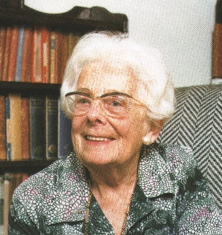
Celebrating Hampshire HistoriansDymond, Dorothy3 July 1891 - 5 September 1985‘DD’, as she was known, was a brilliant young history scholar who spent most of her adult life as an educationalist and played a key role in promoting studies of the history and heritage of the city of Portsmouth. She was born in 1891 in Halifax, Yorkshire, and grew up in a succession of places, determined by the circuit followed by her father, the Revd John Dymond, who was a Methodist minister. Between the ages of 11 and 15 she lived in Portsmouth and attended its High School. Her father in his final years served in Manchester, where DD attended the Manchester Municipal Central High School. From there she won an Exhibition to Somerville College, Oxford, and in 1913 obtained a First in History, seven years before the university formally awarded degrees to women. She went on to King’s College, London, where she studied the Catholic saint, Pope Gregory VII (c1015 – 1085, born Hildebrand of Sovana, for an MA (her father had converted from Roman Catholicism to Methodism). In 1919, after a few years as a schoolmistress, she obtained a Lectureship in Medieval History at Goldsmiths College, London, where she stayed for 13 years. During this time, she was elected to the Council of the Historical Association and wrote two substantial books, A Handbook for History Teachers and Introduction to Medieval History. Later she was to edit a history of Goldsmiths. In 1932 from a field of 47 applicants she was appointed principal of the City of Portsmouth Training College, where she oversaw the building of new premises in Locksway Road for 200 students, all female until 1949. Within a few months, the city faced risks of air-raids and she had to evacuate the students, first to Homerton College, Cambridge, for nearly a year, and later in 1941 to Bishop Otter College, Chichester. In 1946-1953 she sat on the University Grants Committee and in 1957-61 was President of the Association of Teachers in Colleges and Departments of Education. She received a CBE in New Year’s Honours list of 1949 and seven years later retired. She was presented with an honorary D.Litt from the University of Southampton in 1976, the same year that the College of Education (as the Training College had by then been renamed) merged with Portsmouth Polytechnic, which in 1992 gained university status. When she returned to Portsmouth in 1932 she immediately involved herself in cultural affairs and was for six years chairman of the Civic Survey Club founded in that year. Its ‘influence was often decisive in policy-making’, as FAJ Emery-Wallis wrote in an appreciation of her in a Festschrift published to mark her 90th year. In 1952 she was instrumental in the start of the Portsmouth Museums Society (PMS) and was asked to chair it, but declined, promising to do so when she retired, which she did. The PMS not only promoted museums and archives but also the preservation the of the city’s historic military heritage. It also lobbied for a new Central Library, with the Portsmouth History Centre, now situated appropriately by Dorothy Dymond Street (formerly Salem Street). She and the PMS were also keen to appoint a city archivist: from 1955 Margaret Hoad served on a part-time basis for a while and in 1960 Betty Masters was appointed fulltime. The final push came from a letter from the Lord Chancellor's Department pointing out that without a professional archivist Portsmouth was in contravention of the Public Records Act 1958. In 1963 the PMS organized a conference of history teachers, which led four years later to the first of the Portsmouth Papers, published by the council with the involvement of DD. The first was Porchester, by Professor Barry Cunliffe, and within five years 17 titles, including two by DD, had been published - the number now stands at 80. Subsequently, she chaired the editorial committee that in 1971 launched the Portsmouth Record Series, commencing with Borough Sessions Papers 1653-1688, a calendar compiled by Arthur J Willis and Margaret J Hoad. Sources
PortraitContribution to county’s historyShe was for more than 50 years a major force in the promotion of local history and heritage in the City of Portsmouth, its institutions, associations, buildings and publications. Relevant published works
Critical CommentsShe once said that she ‘had chosen an active life of teaching and administration rather than one of scholarly seclusion, [and that] she was “only an amateur historian”’, according to Professor MJ Sydenham, a former Head of the History Department at Portsmouth College of Education, in an appreciation written for her Festschrift. He recalled: ‘Essentially, she offers us the example of an attitude of mind: having the humility to remember that our knowledge is limited, she reminds us that people matter, that what they have done and thought matters, and that all of us today have the right to know and the ability to appreciate the achievement of men and women of the past.’ Other CommentsShe is probably the only Hampshire historian to be given a Festschrift. Interestingly, the example of Portsmouth emphasises that the ways in which local studies have developed in the three main cities of Hampshire today are all substantially different.ContributorBarry Shurlock, 13 04 26 KeywordsMedievalist, educationalist, PortsmouthAny queries or further suggestions for this part of the list should be addressed to celebrating@hantsfieldclub.org.uk.
| |
| Contact Any questions about the web site? Then email Webmaster |
||