
The Hampshire Medieval Graffiti Project is run by volunteers and organised through the HFC Historic Buildings Section. It aims to identify and record historical graffiti in Hampshire to build up an accessible resource for study and research. The Project was set up in 2016 as one of several county surveys inspired by the pioneering work of the Norfolk Medieval Graffiti Survey www.medieval-graffiti.co.uk.
Graffiti is found in most churches and historic buildings and is a valuable part of their history. It provides a rare insight into the concerns and beliefs of ordinary people, whose voices have previously gone unheard or are missing from more formal records.
Much graffiti has been lost due to restoration, weathering and deliberate removal, so it is important that we record what survives. We always provide reports to those who take care of the buildings, so they can appreciate the graffiti, tell others about it, and make sure it isn’t inadvertently damaged in the future. We post reports on this website and send them to the relevant Historic Environment Record, to make them as accessible as possible.
Despite out project’s name, we record all the graffiti we find, because graffiti is often hard to date, and post-medieval and later graffiti can be equally interesting. We record other informal marks left on buildings, for example working marks made by carpenters and stone masons, Ordnance Survey benchmarks and scratch or mass dials.
What are we finding?
- We find many religious symbols such as crosses, and holy monograms, in churches.
- Apotropaic or protection marks, made to protect a building, its occupants and contents from harm, are common. Such graffiti takes the form of symbols like compass-drawn circles and six-petalled rosettes, grid patterns, dots and holes, and intersecting Vs forming shapes resembling the letters W and M. Many of these symbols derive from religious symbolism, but post-Reformation they lost their religious significance and appear in both religious and domestic settings.
- Names and initials, sometimes dated, are the most common finds from the mid-16th century onwards, as literacy increased.
- More rarely we find depictions of ships, people and animals, and outlines of shoe soles and hands.
Graffiti Surveys
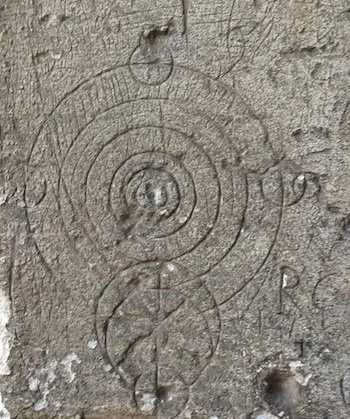
An example of graffiti from the gateway at The Hospital of St. Cross, Winchester.
- You can find which churches have been completed.
- To find out about more about which churches are being surveyed, please email medieval-graffiti@hantsfieldclub.org.uk.
- Past events:
Bringing this corpus of material together will provide an invaluable resource for further study and understanding of the medieval world.
Links:
For more background to this subject there is information online to research the topic.
Newsletter Articles
- Workmen graffiti at the Hospital of St Cross, Newsletter 76, Autumn 2021
- Graffiti findings from St Peter’s church, Goodworth Clatford, Newsletter 74, Autumn 2020
- Discovery of a ‘Lost’ 18c Hospital in Southampton, Newsletter 72, Autumn 2019
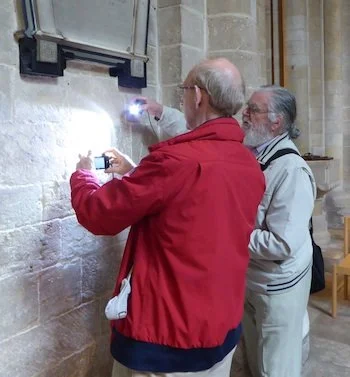
Training taking place at Romsey Abbey.
- The survey was launched on 14th May 2016 when Matt Champion, Director of the Norfolk Medieval Graffiti Survey and author of Medieval Graffiti: the lost voices of England’s churches, led a hands-on training session for volunteers wishing to take part in the survey. This was held at King John’s House, Romsey, where stunning medieval graffiti in a domestic context can be seen.
- A further training session, led by LTVAS members who are carrying out a survey of Romsey Abbey, was held on 16th June 2016; see left.
- Small groups are now being set up to survey the churches in their area, but more volunteers are welcome.
Getting Involved
If you would like to get involved or want to know more, then email medieval-graffiti@hantsfieldclub.org.uk. No previous experience is needed, just enthusiasm and willingness to give some time to explore this fascinating topic.
Training will be provided.