On the 20th March 1885, Thomas Shore, the secretary of the Hartley Institute, the precursor to Southampton University, called a meeting in his room at the Institute to discuss the formation of a society to study the natural history and antiquities of Hampshire. Present at this meeting were William Whittaker of the Geological Survey, the Rev T Woodhouse of Ropley, the Rev W Eyre of Swarraton and Ernest Westlake of Fordingbridge.
The meeting decided that Shore and Westlake should act as secretaries of the newly proposed Club, The Hampshire Field Club, with the initial duties of inviting interested people to become members and of arranging four meetings during the summer months.
In a subsequent meeting on June 12th that year, while new members were being recruited, the rules of the new Club were devised and then adopted by the members during an excursion to Selborne on June 25th. The rules made it clear that, in common with similar clubs and societies established in the late Victorian era the Hampshire Field Club was to have “serious, scientific aims” (Pettigrew 1860)
By the end of 1885 the Club had over a hundred members and within five years the membership had reached 250.
The activities of the club were reported in the Proceedings of the Club, a publication instituted at a committee meeting in July 1885. These were intended to include papers, reports and records of study in in a wide range of fields including botany, entomology, genealogy, geology, numismatics, ornithology and other branches of archaeology and natural science. The publication perpetuates, though after the first hundred years it adopted the primary title of “Hampshire Studies”.
At an that annual meeting, held on April 23rd 1921 new rules of the Club were adopted; the Club was now to be run by a Council rather than a committee, the duties of officers of the Club were clearly set out, and the headquarters of the Club was now to be Winchester.
Over the years the club evolved to become more focused on archaeology, history and the antiquities with some founding interest groups, notably in natural sciences, spinning off into other organisations. The Club adopted the name Hampshire Field Club and Archaeology Society to better reflect its increasing weighting towards archaeology and has now developed into a federation of special interest groups together with a core publications comittee.
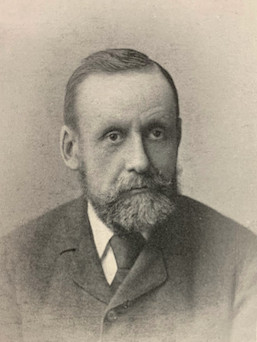
Thomas Shore
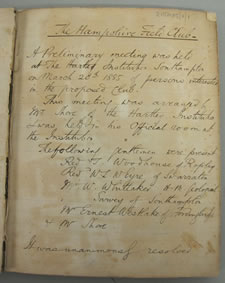
Minutes of the first meeting