Back in April 2026, we heard from the Hampshire Cultural Trust that the St Mary Bourne Iron Age chariot fittings that we helped to purchase in 2023, were about to go on display at the Museum of the Iron Age, Andover. At the same time, the ‘Bullington Brooch’, an unusual item of chariot horse harness, recently donated to the Trust, would also go on view. This happy coincidence calls for a closer look, not just at these finds, but at the wider evidence for Iron Age chariots in northern Hampshire.
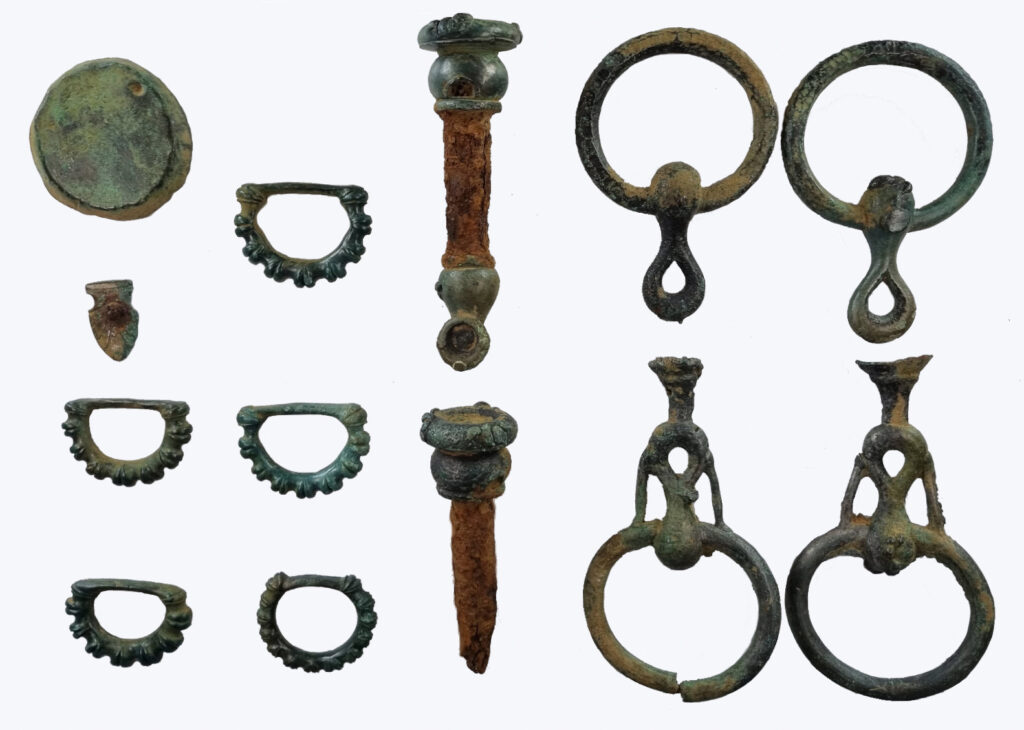
The chariot fittings, a metal detector find reported to the Portable Antiquities Scheme (PAS) and listed as HAMP-D18D76, consisted of horse bits, lynch pins, terret rings and an ingot (above, bottom lynch pin 110mm). Some were cast using the ‘lost wax’ process and the casting gates and jets were still present, showing that they were never used. Their burial, in a small pit, was presumed to have had ‘ritual’ significance.
We discovered more about these items when Dr Sophia Adams, of the British Museum, gave a talk at the November 2023 Archaeology Section Conference. Mention was made of the numerous chariot burials excavated at Wetwang in Yorkshire and how they are rare finds elsewhere in the country. Items of horse harness and chariot fittings are fairly common, however, and a remarkable cache of clay moulds and crucibles found during excavations at Gussage All Saints, Dorset, in 1972, show that they were being manufactured in the south.
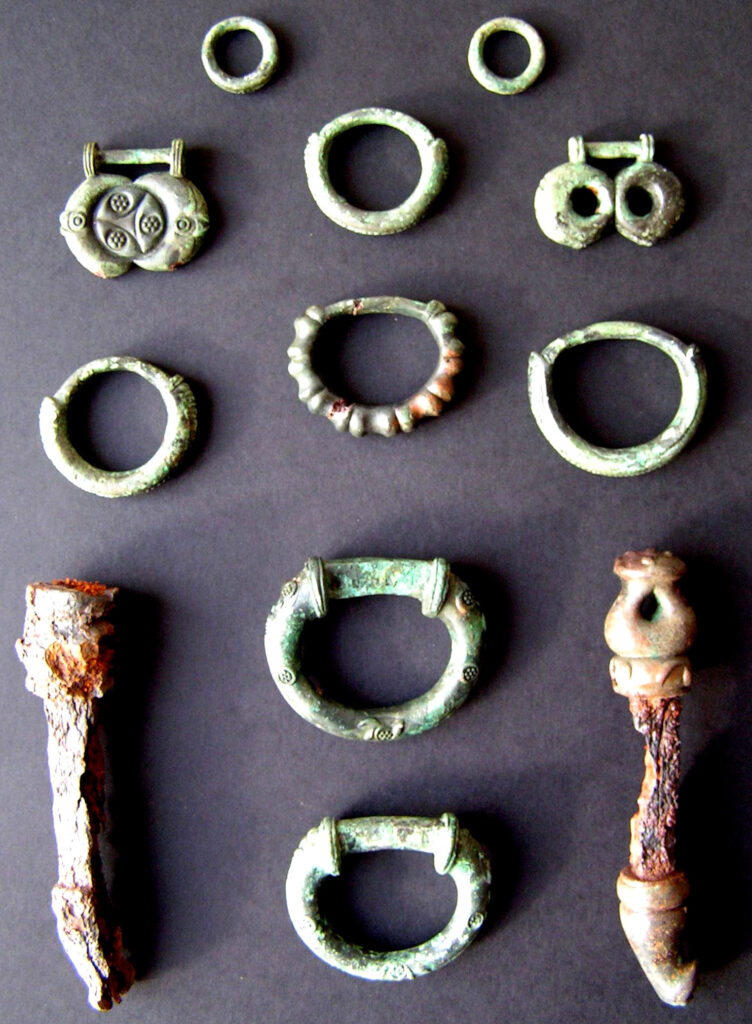
Closer to home, the 1990 excavations at Bury Hill, Upper Clatford, by Professor Barry Cunliffe, have a lot to offer in this regard. Some of the pits excavated inside this Late Iron Age hill fort produced a large quantity of horse harness and chariot fittings (some shown above, right hand lynch pin 122mm). What was more interesting, however, was that 48 per cent of the associated animal bone was of horse. This compares with 3 per cent during most of the lifetime of Middle Iron Age Danebury hill fort. The inference is that towards the end of the Iron Age (1st century BC, 1st century AD) Bury Hill was probably the scene of chariot manufacture and horse training – a veritable ‘chariot school’.
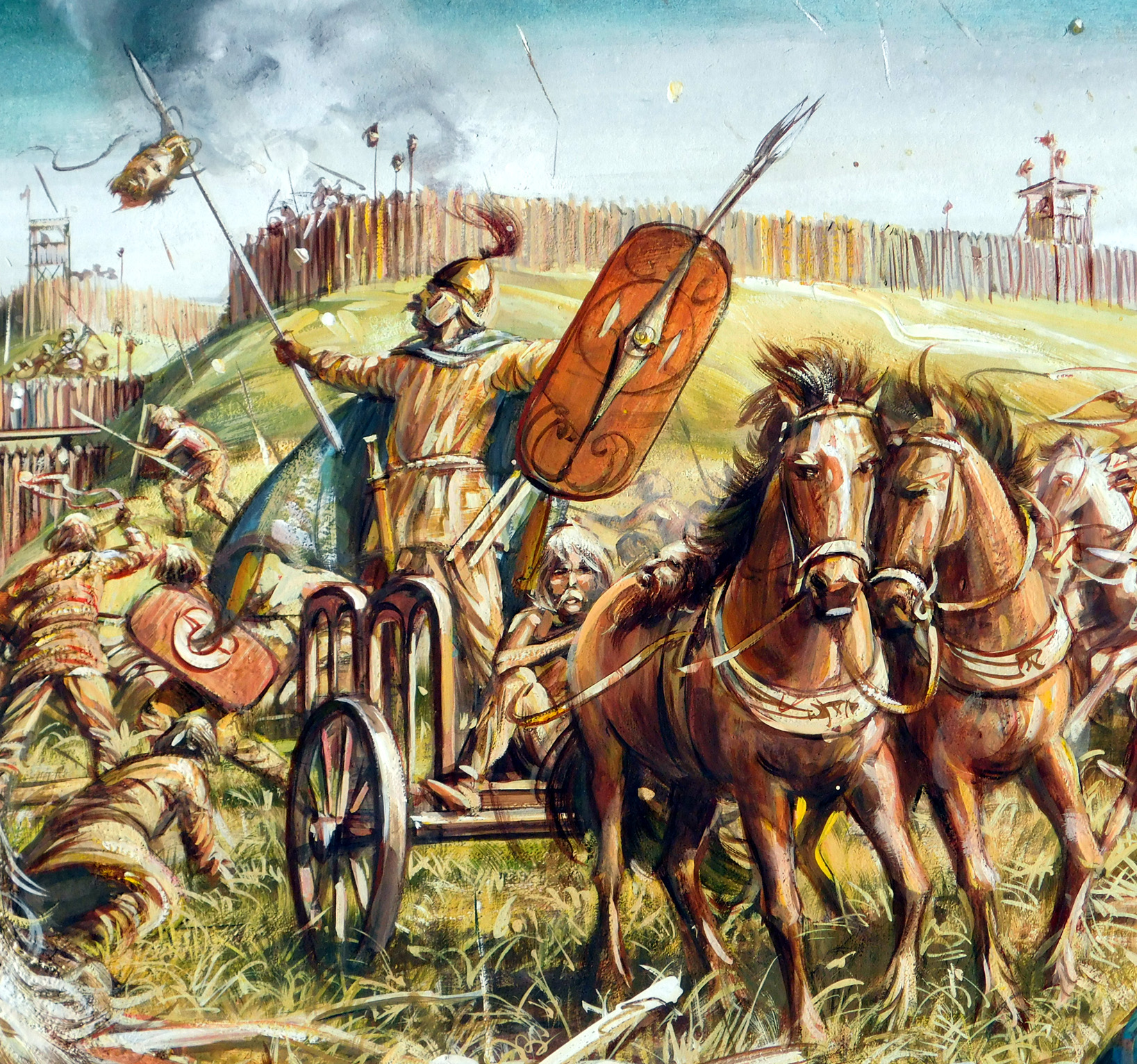
We know from the writings of Caesar and Tacitus that hundreds, if not thousands, of Iron Age warriors who faced the Roman legions used chariots. Their mobility and skill impressed the invaders and made them a force to be reckoned with. One recent study by John Creighton (Coins and Power in Late Iron Age Britain) suggests that the establishment of these bands of followers, or comitates, resulted from the rise of a warrior elite, who could command such a following (Illustration by Mike Codd).
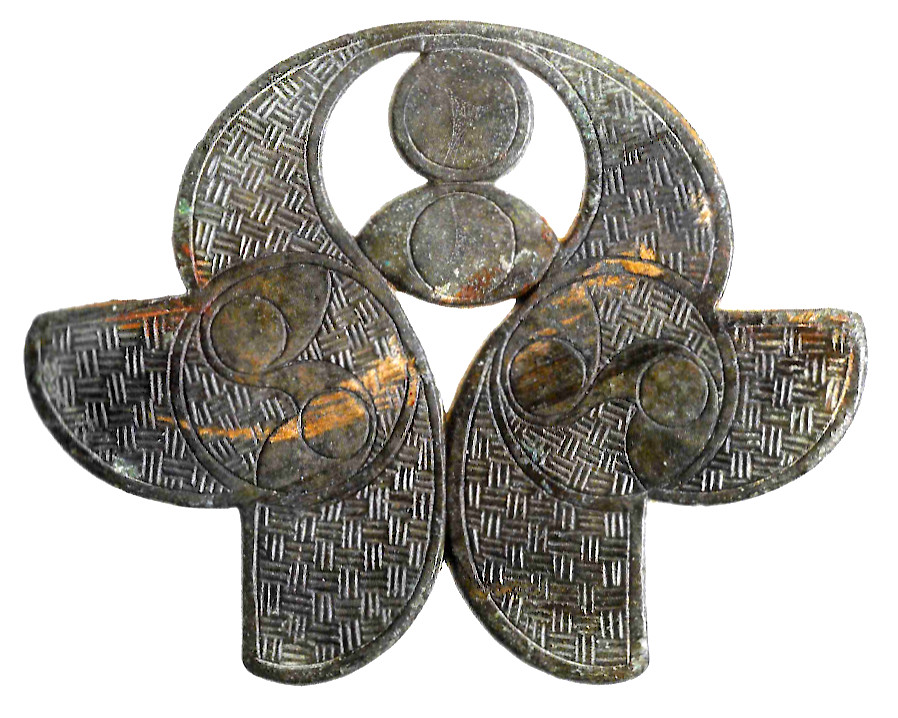
The other item newly placed on display is a Late Iron Age horse or pony brooch found, again with a metal detector, in Bullington parish and recorded as PAS SUR-738A17 (above, 52mm x 69mm). Only ten similar items are known from England and Wales and the basket-weave pattern, which is such a feature of the piece, is rarely used on harness fittings, but is frequently found on mirrors and torcs (neck rings).
The brooch is considered to be of outstanding significance for the study of the horse harness, chariotry, and the crafting of metalwork and textiles. Its function was to join leather straps to a fabric element laid over the back of the pony like a blanket or rug. Textiles at this time were made from organic materials, either animal or plant fibres, typically sheep wool or flax.
The basket-weave pattern on the brooch is a rare glimpse into the design of such fabrics and may indicate the type of textile employed. It consists of three parallel, vertical warp strands that pass over and under three parallel, horizontal weft strands. Clues like this are often the closest indications of what textiles may have looked like at this time.
The designs on the Desborough mirror from Northamptonshire bear a distinct resemblance to those on the brooch, while locally the mirror from Latchmere Green, near Silchester (also on show in the Museum of the Iron Age) exhibits some parallels. John Creighton, in his book, favours the idea that such repetitive geometric forms in Early Celtic art may have been inspired by the visual patterns experienced during altered states of consciousness (from psychoactive plants). But who knows? – Perhaps the weaving came first!
Creighton, John (2000) Coins and Power in Late Iron Age Britain
Cunliffe, Barry & Poole, Cynthia, (2000) Bury Hill, Upper Clatford, Hants, 1990, The Danbury Environs Programme Vol 2 – Part 2.