| Programme of EventsMembershipPublicationsEditorial BoardOfficers | Library | Medieval Graffiti Survey |
|
|
Hampshire Field Club & Archaeological Society |
| Registered Charity number 243773 | HomepageArchaeologyHistoric Buildings Hampshire Papers LandscapeLocal History |
 |
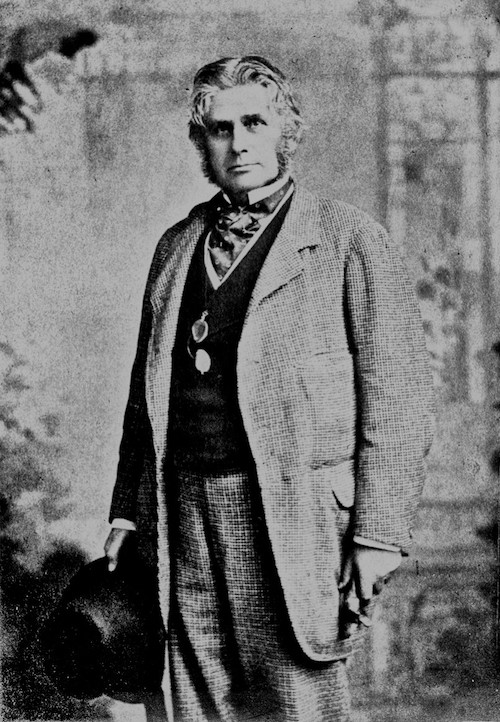
Celebrating Hampshire HistoriansPitt Rivers, Augustus Henry Lane-Fox, FRS, FSA, FRAI14 April 1827 – 4 May 1900Hampshire can lay claim, in a small way, to some of the archaeological work of General Pitt Rivers, the country’s first Inspector of Ancient Monuments. In the mid 1890s his investigation of sites on Cranborne Chase spilled over into the county and Martin Down and Bokerley Dyke are included in his impressively produced excavation volumes. Pitt Rivers enjoyed a remarkable life, with an unexpected inheritance that allowed him to indulge his fascination for the evolution of artefacts, for anthropology and archaeology. Augustus Henry Lane-Fox was born near Wetherby, Yorkshire. At the age of fourteen he was commissioned into the Grenadier Guards as an ensign, at the start of a 32-year military career. He only once experienced front-line action, however, at the Battle of Alma in 1854. Instead, his principal duties revolved around the Hythe School of Musketry and in 1858, he published a paper entitled ‘On the improvement of the rifle as a weapon for general use’. A series of promotions culminated in the rank of major general and on retirement he was given the honorary rank of Lieutenant General. By this time, he had cultivated an interest in archaeology and ethnology, both through his time spent abroad and by visiting excavations carried out in Yorkshire by Canon Greenwell. He formed an artefact collection demonstrating the evolution of weapons and tools and the development of human invention, which became famous and was exhibited at the Bethnal Green Museum in 1874. In 1880, Lane Fox inherited an estate of more than 27,000 acres in Cranborne Chase from a cousin, Lord Rivers, and adopted the Pitt Rivers name. The inheritance was ‘an event that transformed his life’, as the estate contained a wealth of archaeological material from the Bronze Age to the Saxon period. He set about exploring this in systematic fashion and his focus on the everyday objects found in his excavations, rather than ‘treasure’, plus his meticulous recording methods, established his reputation as one of the founding fathers of British archaeology. Cranborne Chase, though mostly in Dorset and Wiltshire, overlaps into the western reaches of Hampshire and Pitt Rivers pursued his digging exploits into the realms of neighbouring landowners, such as Eyre Coote of Rockbourne. In 1895-6, he thoroughly examined an enclosure on Martin Down, finding Bronze Age and Roman pottery and also sampled a nearby bank and ditch system, since shown to be of Iron Age date. Contrary to his usual practice, and presumably at the request of landowner or tenant, he did not, on this occasion, restore the enclosure ditches to their original two-metre-deep profile. By this time, Pitt Rivers had established a number of locations, including the Larmer Tree Gardens at Rushmore, Wiltshire and a small museum at Farnham, Dorset to be used for public education and entertainment. He had also donated more than 20,000 artefacts to the University of Oxford (1884) which formed the basis of the Pitt Rivers Museum. Another national initiative coming to fruition at this time was the Ancient Monuments Act (1882). Pitt Rivers was appointed as the first Inspector of Ancient Monuments, but the weaknesses inherent in the Act made it a fairly thankless task. Despite his interest in public education, Pitt Rivers had a fierce temper and to judge from the diary kept by his daughter Agnes, was something of a domestic tyrant. He appears to have avoided emotional contact but put his incredible energy into collecting, studying and ordering objects in meticulous detail, objects which ultimately formed the basis of two major museums. Sources
Portrait
Contribution to county’s historyPitt Rivers work at Martin Down and Bokerley Dyke ensured that Hampshire sites were included in his classic volumes ‘Excavations in Cranborne Chase’. Relevant published works
Critical CommentsOther CommentsContributorDave Allen, November 2023 Key Wordsarchaeology, Ancient Monuments, ethnology, anthropology, education Any queries or further suggestions for this part of the list should be addressed to celebrating@hantsfieldclub.org.uk.
| |
| Contact Any questions about the web site? Then email Webmaster |
||