| Programme of EventsMembershipPublicationsEditorial BoardOfficers | Library | Medieval Graffiti Survey |
|
|
Hampshire Field Club & Archaeological Society |
| Registered Charity number 243773 | HomepageArchaeologyHistoric Buildings Hampshire Papers LandscapeLocal History |
 |
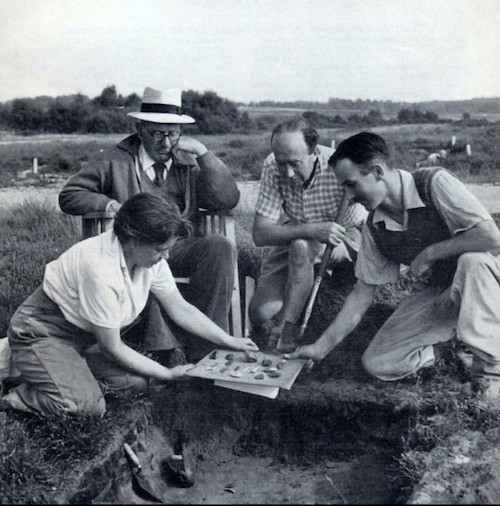
Celebrating Hampshire HistoriansRankine, William Francis1877 - 28 March 1962W F Rankine was a Scot who spent much of his time in Surrey. He was at school in Dorking, and taught for many years at Badshot Lea, near Farnham. His interests were wide, covering birds, wild plants, fossils and archaeological remains, and he had ‘the rare gift of instructing and enthusing others’ in these pursuits. The first archaeological site of importance he encountered was that of the Mesolithic remains, with an abundance of flint implements and evidence for contemporary dwellings, on part of the land of the Farnham sewage works. This he investigated, between 1929 and 1935, in co-operation with Dr J G D Clark and published in the Surrey Collections and Proceedings of the Prehistoric Society. He then discovered a Neolithic long barrow at Badshot Farm and excavated there in conjunction with Alexander Keiller and Professor Stuart Piggott. Rankine’s expertise in the archaeology of the Mesolithic saw him at work in neighbouring counties. He was particularly busy in Hampshire, either at the invitation of those seeking advice, or by following the Greensand and heathlands, which are so productive in Middle Stone Age evidence and show no respect for local authority boundaries. In the mid-1930s Sir Thomas Troubridge and Commander Wrey were finding distinctive Mesolithic material in the latter’s garden at Boarmans, Beaulieu and called upon Rankine ‘well known…for his outstanding work on the Mesolithic sites of West Surrey’ to comment on the eight hundred pieces of flint they had amassed. By contrast, in the mid-1950s, Rankine had collected sufficient evidence to publish a summary of the 40 square miles of the Hampshire Greensand, detailing how War Department use of some of the area had exposed chipping floors consisting of tens of thousands of flints among the post-glacial wind-blown sands. Sites such as Oakhanger, Kingsley Common, Woolmer and Longmoor demonstrated both the abundance of material to be found and the fragility of such material in the face of military training areas and other disturbance. Rankine’s obituary in the Surrey Archaeological Collections remarks on his never-failing cheerfulness and enthusiasm and how he was planning still further work in the area and commends his two major research papers ‘A Mesolithic Study of the West Surrey Greensand’ and ‘The Mesolithic of Southern England’. SourcesObituary, Surrey Archaeological Collections 61, 1964; Jacobi R (1981) 'The Last Hunters in Hampshire' in Shennan & Schadla-Hall (eds) The Archaeology of Hampshire, Hants Field Club & Archaeol Soc, Mono 1.10-25 PortraitW F Rankine (seated) Mrs Rankine, LW Carpenter and J C Draper. From the cover of an Archaeological Newsletter, 1958. Contribution to county’s historyRelevant published works
Critical CommentsOther CommentsContributorDave Allen - May 2024 Key WordsMesolithic archaeology; Hampshire greensand; Beaulieu Any queries or further suggestions for this part of the list should be addressed to celebrating@hantsfieldclub.org.uk.
Back to Historians R-T from Ravenscroft, William to Trussell, John | |
| Contact Any questions about the web site? Then email Webmaster |
||