2024 Annual General Meeting
Thursday 28th November 2024 at 19.30 at King John’s House, Romsey, SO51 8BT

The AGM was followed by a talk on King John’s House by Frank Green. Following the talk refreshments were provided and time allowed for the building to be viewed.
King John’s House is a good example of a surviving 13th century stone chamber block, the remaining portion of a much larger complex of buildings with associations to Romsey Abbey. First recognised as a medieval building in 1927, the talk explored the architecture, dating and interpretation of the building, its local setting and its later history. The earliest medieval archaeological evidence from excavations on the site is from the 13th century. The building and the associated ‘Tudor Cottage’ have a fascinating history from the 16th century when the property was part of the Abbey’s possessions acquired by the abbey steward. The site was variously occupied by bronze workers, fellmongers and used as the parish workhouse before becoming slum cottages. The talk will take place in the upstairs stone chamber of the building where the medieval graffiti can be viewed, and its significance explained.
The Inaugural Edward Roberts Memorial Lecture
Thursday 31st October 2024 at 7.30 pm In the Lecture Theatre at the Hampshire Record Office, Sussex St, Winchester

Edward was a founder member of the Historic Buildings Section Committee and served on it until his recent death.
This first lecture in his honour was given by Dr Martin Bridge, recently of the UCL Institute of Archaeology but now academically semi-retired. It would be hard to identify anyone more suited to the role. In addition to his academic responsibilities Martin is an internationally practicing dendrochronologist and, with his colleague, Dr Dan Miles, represents the Oxford Dendrochronological Laboratory - the go-to consultancy for those with responsibility for some of the country’s most important historic buildings. Together they did nearly all the dating work incorporated into the early printings of Edward’s book, Hampshire Houses 1250-1700, and it is largely due to the dates that they produced that Hampshire has a more comprehensive data base for its timber framed buildings than any comparable county.
Martin is at the heart of the still evolving science of dendrochronology, and he touched on some of its recent advances as well as sharing his recollections of working with Edward.
Visit to Christchurch Priory, Dorset
Saturday 1st June 2024 at 11:00 am
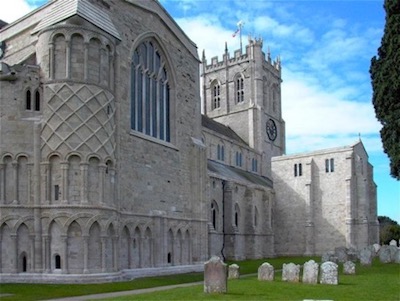
The Priory is one of England’s most magnificent parish churches, lost from Hampshire to Dorset when boundaries changed in 1974. It is in a spectacular setting overlooking Christchurch Harbour and contains a wealth of stunning features from the 12th century onwards, including 4 chantry chapels, and is home to the legendary Miraculous Beam. Tours of the ground floor and the roof spaces which have finely preserved carvings and painted schemes were provided, led by experienced guides.
Visit to Herriard: Church, Landscape & House
Sunday, 19 May 2024, 2.00 pm at Herriard church, with Dr John Hare
Herriard House: one of Hampshire’s lost great houses
This visit provided an opportunity to examine the remains of a seigneurial complex in NE Hants with a much wider significance than Herriard itself. The small medieval church was typical of many in the area, and includes evidence of several phases of medieval alterations. It shows the impact of the lord both in the 17th century screen, and in the remodelling and enlargement of the church in the 19th century.

Herriard Church.
There was the opportunity to look at the church and to have an illustrated introduction to the development of the area. A walk to the house provided the opportunity to see something of the development of the landscape: the remnants of a lost village, the late 17th century parkland with its formal long drives, and the rejection of this approach in the late 18th century with the more ‘naturalistic’ landscape of Repton. We also saw the stable block and the octagonal walled garden. The great house was built 1703-6, the earliest known work of John James an important architect of the period. It was remodelled in the later 18th century and survived until 1960s when, like a number of other great Hampshire houses, its unsuitability for the demands of a late 20th century household led to its demolition and the construction of a new house incorporating a few fragments of its predecessor. In addition, the old house survives in the original architect’s drawings and in a remarkable wooden model.
The Historic Buildings Section is extremely grateful to the owners, Mr and Mrs John Jervoise for making possible this visit.
|

