
| Programme of EventsMembershipPublicationsEditorial BoardOfficers | Library |
|
|
Hampshire Field Club & Archaeological Society |
| Registered Charity number 243773 | HomepageArchaeologyHistoric Buildings LandscapeLocal History |
 |
Stockbridge Marsh & DownJointly with the Alton Natural History SocietyOn Saturday 15 July 2006, Around 25 members of the Field Club and the Alton Natural History Society met in the car park at the north east end of Stockbridge Marsh. The walk was led by Ted Raynor of the Alton Natural History Society.We first stopped at the northern hedgerow, where a range of butterflies were identified: the Comma with its distinct white C-shaped mark on the underside of the hind wing; the Gatekeeper, which has a single ocellus or eye-spot and which is a defence against bird attack; the Meadow Brown, the Large White, Red Admiral which overwinters in the south and is supplemented by migrants from the continent. The main food source for all these butterflies was the bramble blossom. The water also provides habitats or food sources for birds. The house martins flew low over the water in their search for insects; it was noted that there has been a significant drop in insect numbers over recent years. A little grebe was sitting on its nest while young moorhens were observed in their search for food. A female mandarin duck was spotted in an inlet off the river; this bird is becoming common on Hampshire's rivers and in the New Forest. The reed warblers were identified by their singing, while there were glimpses of a kestrel and a sparrow hawk in flight. The green woodpecker was recognisable from its distinctive flight, which is described as "…deeply undulating, with long wing-closures between each upward bound."
The down has a range of chalk flora. Marjoram was in flower; it is a good food source for a range of butterflies. The blue flowers of the Harebell were in blossom; Lady's Bedstraw, Eyebright, Wild Carrot and Wild Basil were also in evidence. Unfortunately the timing of the season did not allow us to see the Frog Orchid in flower. The weather was suitable for several species of butterfly and we saw, early Chalkhill
Blue, Marbled White, Meadow Brown, Small Heath, Brimstone, Peacock and Gatekeepers.
There was discussion of a number of matters related to their lifestyles. The Brimstone
feeds up early in the summer to allow it to hibernate to avoid the heat, which can dry
it out. The Peacocks were also the result of breeding in the spring and they too were
feeding to allow them to hibernate and overwinter. It was suggested that the Small
Heath was the commonest butterfly. The Gatekeeper has a habit of flying to a hilltop
where numbers of the species meet to fly together. |
|
| Contact Any questions about the Landscape Section? Then email Mike Broderick Landscape Section Chairman |
||
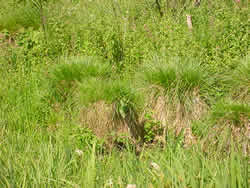 The damp
marginal conditions suit a range of flora, including meadow sweet, purple
loose strife, hemp agrimony and tussock sedges. The study of the last
of these is a specialised field of expertise. The tussocks can reach
as much as 1.3 metres high and 1 metre wide, with stiff 1-1.5 metre
stems and long leaves, though the examples shown in this photo are around
half that size.
The damp
marginal conditions suit a range of flora, including meadow sweet, purple
loose strife, hemp agrimony and tussock sedges. The study of the last
of these is a specialised field of expertise. The tussocks can reach
as much as 1.3 metres high and 1 metre wide, with stiff 1-1.5 metre
stems and long leaves, though the examples shown in this photo are around
half that size.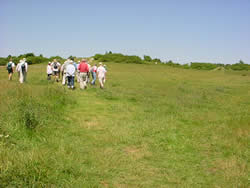 After
lunch we visited Stockbridge Down. This area of chalk
downland (SU379349), a mile to the east of Stockbridge, rises to a height
of 158 metres in the north with the ground sloping steeply down to the
north-west and more gently to the south and east. The National Trust
has more actively managed the down in recent years with scrub clearance
and the fencing off of some parts. As the picture shows, it is grassland
with some bushes and trees on the high ground.
After
lunch we visited Stockbridge Down. This area of chalk
downland (SU379349), a mile to the east of Stockbridge, rises to a height
of 158 metres in the north with the ground sloping steeply down to the
north-west and more gently to the south and east. The National Trust
has more actively managed the down in recent years with scrub clearance
and the fencing off of some parts. As the picture shows, it is grassland
with some bushes and trees on the high ground.